
If you're wondering whether Crayola markers are safe for your kids, you can relax. The short answer is no, Crayola markers are not toxic. They are specifically designed and certified to be safe for children, so accidental doodles on the skin or even a curious taste are highly unlikely to cause any real harm.
What Makes Crayola Markers Safe
When you grab a box of Crayola markers, flip it over and look for the AP (Approved Product) seal. This little symbol is your assurance of safety. It means the markers have been put through a tough evaluation by independent toxicologists and are confirmed to be safe for everyone, especially kids.
This certification comes from the Art & Creative Materials Institute (ACMI), the organization that sets the bar for art supply safety in the U.S. In fact, Crayola states that 100% of their art materials proudly display this seal. This seal also confirms compliance with a federal standard called ASTM D-4236, which mandates clear labeling for any potential health hazards on art supplies. For more details straight from the source, you can always check out the official safety information on Crayola's support page.

Crayola Marker Safety At a Glance
For parents and teachers, that AP seal is peace of mind in a box. It means you can let kids create, explore, and get a little messy without hovering over them worrying about dangerous chemicals.
To make it even clearer, here’s a quick summary of why these markers are a go-to choice for safe art projects.
| Safety Aspect | Rating / Status | What This Means for Parents |
|---|---|---|
| Toxicity Certification | AP (Approved Product) Seal | Certified non-toxic by toxicology experts. Safe for art projects. |
| Primary Ingredients | Water and Pigments | The formula is simple, avoiding the harsh solvents found in other markers. |
| Accidental Ingestion | Low Risk | Swallowing a small bit of ink is unlikely to cause more than a minor upset. |
| Skin Contact | Non-Irritating | Designed to be washable and gentle, so it won't irritate the skin during normal use. |
Ultimately, this all means less worrying and more time for what matters: letting your little artist’s imagination run wild.
What "Non-Toxic" on a Crayola Box Actually Means
That "non-toxic" label on a box of Crayola markers is reassuring, isn't it? But what does it really guarantee? It’s not just a marketing buzzword; it’s a regulated stamp of approval that means the product has been thoroughly evaluated by toxicologists.
This label certifies that the markers are safe for their intended use—drawing and coloring. Think of it this way: soap is non-toxic for washing your hands, but you wouldn't eat a bar of it for lunch. Similarly, Crayola markers are perfectly safe for art projects, even if a child gets some on their skin, but they aren't meant to be ingested.
The label is a promise of safety under normal, expected circumstances.
Who Decides What's Safe?
The main group overseeing art supply safety is the Art & Creative Materials Institute (ACMI). This isn't just some industry club; it's an organization of toxicology experts who rigorously test products. When you see the ACMI's AP (Approved Product) seal, it's their official certification that the product is non-toxic.
This whole process is governed by a federal standard called ASTM D-4236. This law mandates that all art materials sold in the U.S. undergo an analysis for potential chronic health risks. If a marker contained chemicals in quantities large enough to be dangerous, it would be legally required to have a warning label. Crayola markers, with their AP seal, have passed this test with flying colors.
The bottom line? If a child accidentally swallows a bit of ink or gets it on their hands, it's not expected to cause any serious or long-term health issues. The entire system is built to protect the most curious and vulnerable users: our kids.
Practical Tips for Parents and Teachers
Knowing what these labels mean helps you shop smarter. When you're buying any art supplies, looking for that AP seal is the quickest way to verify safety. It's a simple check that helps you differentiate between kid-friendly products and professional-grade materials that might contain harsher chemicals.
Here are a few simple ways to keep coloring time fun and worry-free:
- Teach the Rules: Gently explain that markers are for paper—not for drawing on themselves, their siblings, or for taste-testing. For example, you can say, "Markers help the paper look beautiful, but our skin likes soap and water, not marker ink!"
- Supervise Little Ones: Always keep a close eye on toddlers and young children who are naturally inclined to put things (like marker caps) in their mouths. This is the best way to prevent choking hazards.
- Stick with Washable: Washable markers are a great choice. They're specifically designed to clean up easily from skin and clothing, which minimizes any chance of skin irritation.
By understanding what these certifications mean, you can create a safe space for creativity to flourish. And if you're interested in making your entire home a healthier environment, it's worth learning about other important safety standards. This guide to understanding certifications like GREENGUARD Gold is a great place to start, as it explains how products are tested for low chemical emissions.
What’s Really Inside a Crayola Marker?
Ever paused to wonder what’s actually in that colorful marker your kid is happily scribbling with? It's a fair question. The good news is that the formula for a Crayola marker is intentionally simple and safe, built around a few core components to keep art time worry-free.
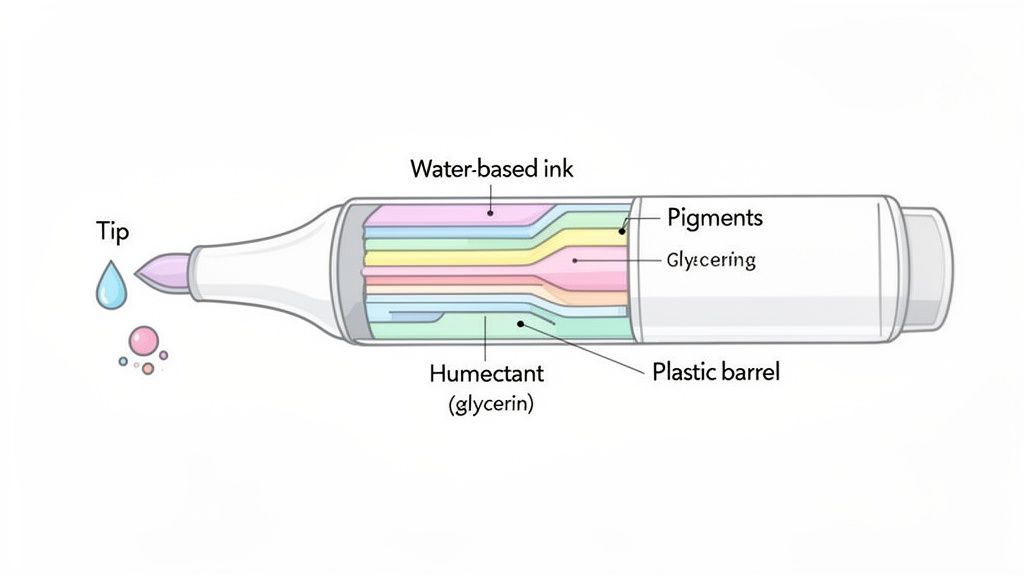
At its heart, a Crayola marker is mostly just water. This water-based formula is the key to why they’re so kid-friendly. It’s a stark contrast to permanent markers, which rely on harsh chemical solvents like xylene or toluene to make their mark. A water base means the markers are a breeze to clean up—a huge relief for parents staring at a newly decorated wall.
The Building Blocks of a Bright Color
So where do those brilliant colors come from? They’re created with pigments, which are essentially very fine, colorful powders. Think of them like the safe colorants you'd find in cosmetics or even some foods. Crayola specifically selects pigments that are stable and, most importantly, safe for little hands.
The final key ingredient is a humectant, usually something like glycerin. A humectant’s job is to hold onto water, which is what keeps the marker tip from drying out between art projects. It’s the same kind of ingredient that helps your skin lotion keep your hands moisturized. This simple trio—water, pigment, and a humectant—is all it takes to make the reliable, non-toxic ink we all know.
By sticking to these basic, proven ingredients, Crayola ensures its markers remain safe for even the youngest artists. There are no secret solvents or alarming additives; the simplicity of the formula is its greatest safety feature.
Proof in the Paperwork
You don’t just have to take our word for it. For anyone who likes to see the data, the official Safety Data Sheets (SDS) for Crayola markers offer a technical breakdown of their ingredients and safety ratings. These documents are the gold standard for verifying why these products are considered non-toxic.
For instance, the SDS for their washable markers clearly states that they are not classified as carcinogenic, mutagenic, or a reproductive toxin. On top of that, they earn a health hazard rating of 0 on industry-standard scales (NFPA/HMIS), which signals minimal risk. The reports also confirm that 0% of the mixture consists of ingredients with unknown acute toxicity. Every single component has been vetted.
If you’d like to dig into the technical details yourself, you can read more about Crayola's safety classifications online. This level of transparency really confirms that when you give a child a Crayola marker, you’re handing them a tool designed with their well-being as the top priority.
What Happens When Kids Don't Use Markers as Intended?
Let's be realistic: kids are going to be kids. No matter how many times we say, "Markers are for paper," they'll find their way onto hands, faces, and sometimes even into mouths. It's a universal parenting experience, so let's walk through what actually happens in these moments.
While Crayola markers are designed to be safe, knowing what to expect and how to react can give you some much-needed peace of mind. The good news is that these situations are almost always minor, but a little knowledge goes a long way. "Non-toxic" means that accidental, small-scale exposure isn't expected to cause any real harm.
If They Chew on or Swallow a Piece
It’s the classic toddler move—the marker goes straight for the mouth. Maybe they’re just gnawing on the cap, or maybe they’ve managed to bite off the felt tip. While it’s certainly not something to encourage, the tiny amount of ink they might ingest is highly unlikely to be dangerous.
The worst you'll likely see is a bit of a tummy ache or some colorful evidence in their mouth or a future diaper. The plastic parts are also made from non-toxic materials. Honestly, the much bigger risk in these scenarios is choking on a cap or a small plastic piece, not the ink itself.
What to Do If Ingestion Happens:
- Don't Panic: Your calm demeanor will keep your child from getting scared.
- Clear Their Mouth: Gently remove the marker and any bits and pieces.
- Give Them Some Water: A sip of water will help rinse out their mouth and dilute whatever ink they swallowed.
- Do Not Induce Vomiting: This can do more harm than good and simply isn't necessary.
- Just Watch Them: Keep an eye on your child. If they're acting normally, you're in the clear.
When They Turn Themselves into a Masterpiece
It happens to the best of us. You turn your back for one second and suddenly you have a little Picasso covered head-to-toe in blue squiggles. It might look alarming, but the ink in washable Crayola markers is completely safe for skin contact.
Because these markers are water-based, they are formulated to be non-irritating for almost everyone. That "washable" label is your best friend—it means the ink is designed to come off skin, clothes, and most surfaces with a little soap and water.
A Pro Tip for Art Time: Set up a dedicated "creation station" before you start. An old plastic tablecloth or some newspaper spread on the floor does wonders. It protects your stuff and also subtly teaches kids that ink belongs on the paper, not everywhere else. For a fun twist, give them a large cardboard box to color inside—it feels like a secret fort and contains all the mess.
What About Inhaling the Fumes?
Parents sometimes notice a faint smell from the markers and worry if it's safe to breathe in. With water-based markers like Crayola's, this is a non-issue. They don't contain the harsh chemical solvents or volatile organic compounds (VOCs) that you'd find in permanent or dry-erase markers.
Those are the types of markers that produce strong, potentially harmful fumes. The barely-there scent of a Crayola marker is perfectly harmless. As with any indoor activity, just having some decent airflow in the room is always a good idea. It keeps things fresh and makes art time fun and worry-free.
Why Not All Art Markers Are Created Equal
It’s easy to assume a marker is just a marker, but that's a dangerous oversimplification. The reassuring safety you get with a classic Crayola marker just doesn't apply to every art supply on the shelf. Think of it like the difference between tap water and rubbing alcohol—both are clear liquids, but you wouldn't use them interchangeably. The same sharp distinction exists in the world of markers.
Understanding this is the first step to keeping creative time truly safe. Children’s markers, like Crayola's, are water-based and designed from the ground up with a kid's unpredictable behavior in mind.
On the other hand, permanent markers, dry-erase markers, and professional-grade art pens are a different beast entirely. They often rely on industrial-grade solvents like xylene, toluene, or various alcohols to make the ink stick and dry quickly. These chemicals pack a punch, releasing strong fumes that are not safe for a child to breathe in, especially in a small, closed-off room.
The Clear Difference in Marker Types
So, how do you tell the good from the bad? Your best friend here is the ACMI AP (Approved Product) seal. Seeing that little logo means a toxicologist has personally reviewed the product and certified it as safe for children. When you grab a marker without that seal, you're stepping into unknown territory with its chemical makeup.
This isn't just theoretical. A 2018 investigation into school supplies found that while Crayola products were clean, certain magnetic dry-erase markers from another brand contained benzene, a known carcinogen. That's a stark reminder that the brand and type of marker you choose really, really matter. You can read the full findings from the school supply investigation to see just how wide the safety gap can be.
Kids have a knack for getting things everywhere, which is exactly why picking the right marker is so important. The main risks aren't just from a child chewing on a cap.

As you can see, exposure can happen through ingestion (eating), skin contact (drawing on themselves), or inhalation (breathing in fumes). This is why you need products designed to be harmless across all these scenarios.
To make this crystal clear, let's break down the most common marker types you’ll find on store shelves.
Children's Markers vs. Other Marker Types
| Marker Type | Primary Base | Common Chemicals of Concern | Recommended For |
|---|---|---|---|
| Children's Washable Markers | Water & Food-Grade Dyes | None; designed to be non-toxic | Young children for everyday art and school projects |
| Permanent Markers | Alcohol, Solvents | Xylene, Toluene, Propanol | Adults and older teens for labeling, posters, industrial use |
| Dry-Erase Markers | Alcohol | Ethanol, Isopropanol | Whiteboards in well-ventilated classrooms or offices; for use by adults |
| Professional Art Markers | Alcohol, Solvents | Various alcohols and proprietary solvents | Professional artists and designers; requires proper ventilation |
The takeaway here is simple: stick with products explicitly designed and tested for kids. The performance features of professional or permanent markers come from chemicals that have no place in a young child's hands.
Coloring Advice: Keep your art supplies separated. Store permanent markers, highlighters, and dry-erase markers high up or in a locked cabinet where little hands can't reach. Create a dedicated "kid-safe" art bin filled only with AP-certified crayons, washable markers, and paints. This one organizational habit can prevent accidental mix-ups and give you total peace of mind during creative time.
Actionable Safety Tips for Worry-Free Art Time
Knowing Crayola markers are non-toxic is a huge relief, but a few simple habits can turn any art session from safe to truly worry-free. Being proactive means you can spend less time hovering and more time watching their imagination take flight. These tips are all about creating a great space for creativity to bloom without any of the stress.
The number one rule? Always supervise young children during art time. It’s just how they’re wired—toddlers and preschoolers explore the world with their mouths, and marker caps can look awfully tempting. Your presence is the best defense against accidental ingestion and a great way to gently guide them on how to use their tools.
It also helps to teach them the "paper only" rule early on. While washable markers are a lifesaver, establishing good habits from the start is even better. Remind them that markers are for drawing, not for decorating skin, clothes, or the living room wall.
Smart Shopping and Safe Storage
Most potential issues can be avoided before you even get the markers home. A little mindfulness when you're shopping and storing supplies makes all the difference.
- Look for the ACMI AP Seal: Make this a non-negotiable habit. When buying any art supplies, from crayons to paint, always hunt for that AP (Approved Product) seal. It's your guarantee that the product has been certified non-toxic.
- Keep the Air Fresh: Crayola markers don't give off nasty fumes, but it’s always a good idea to have some fresh air circulating. A cracked window is perfect for those long, super-focused crafting sessions.
- Store Markers Securely: Make sure caps click back on tightly after every use. This does more than just keep the markers from drying out; it keeps those small caps away from little ones who might see them as a choking hazard.
Here's a fun trick: Turn cleanup into a "marker check" game. At the end of art time, have your child help you count all the markers and make sure every single one has its cap on tight before they go back in the box.
Thinking about marker safety is just one piece of the puzzle. A holistic approach to child safety means being mindful of everything they interact with. For instance, you might also find helpful information in a parent's guide to cleaning baby toys safely. Staying informed helps you build a consistently safe and nurturing environment where your kids can play and grow.
Frequently Asked Questions About Marker Safety
Even knowing Crayola markers are non-toxic, every parent has those "what if" moments. It's totally normal. Let's walk through some of the most common questions and give you some straightforward, practical advice for handling those inevitable coloring mishaps.
Knowing what to do ahead of time means you can handle these little situations calmly and get right back to the fun.
What Should I Do If My Child Chews on a Crayola Marker?
First things first: don't panic. Gently take the marker away and check their mouth for any broken plastic pieces. The ink and the plastic are non-toxic, so this is almost always a non-issue.
Give them a sip of water to help rinse everything out. If you're still feeling anxious—and that's okay!—you can always call your local Poison Control center. They are available 24/7 and are absolute pros at handling these exact kinds of calls. They'll give you quick, expert reassurance tailored to your child's age and the situation.
Are Crayola Washable Markers Safe for Face Painting?
This is a big one. While the markers are non-toxic and wash off skin, they are not made or tested for use as cosmetics. Face paints and other products designed for skin go through rigorous dermatological testing to make sure they won't cause rashes, irritation, or allergic reactions. Markers just aren't built for that.
Coloring Advice: Stick to paper for the markers. When your little one wants to be a tiger or a superhero, grab some cosmetic-grade face paints that are actually designed for that job. A practical example is planning ahead for a birthday party or Halloween by buying a certified non-toxic face paint kit instead of reaching for the markers in a pinch. It’s always better to be safe.
Do Crayola Products Contain Common Allergens?
Crayola does a good job here. They state that their products are generally formulated without the most common allergens like peanuts, tree nuts, milk, eggs, or gluten. That's a huge relief for many families.
However, there's a small catch. They can't 100% guarantee that the raw materials they get from outside suppliers haven't come into contact with allergens somewhere along the way. If your child has a severe allergy, the best and safest route is always to check with their doctor before using any new product, art supplies included.
At Colortada, we believe creativity should be joyful, not stressful. We have thousands of printable coloring pages from your child's favorite characters and shows to keep the fun going safely.
Discover endless creative possibilities at https://www.colortada.com.