
You don't need to be a seasoned artist to draw a beautiful flower. The real secret? It's all about seeing the simple shapes hidden inside—circles, ovals, and a few curved lines. Once you can spot those, you can draw anything.
We'll start with a circle for the flower's center, then add simple petal shapes around it, and finish with a stem. This simple method makes drawing a joy for everyone, from kids just learning to hold a pencil to adults looking for a relaxing new hobby.
Your First Steps in Drawing Flowers
Ready to get started? This guide is designed to be a fun, creative launchpad, especially for parents and teachers who want to bring a little artistic magic into a child's day. Drawing flowers is more than just a fun pastime; it’s a brilliant way to build up those fine motor skills and let the imagination bloom, all without needing a professional art studio.
In fact, you probably already have everything you need. Just grab these basics:
- A pencil for your initial sketch
- A good eraser for any stray lines
- Some paper (any kind will do!)
- Your favorite coloring supplies—crayons, markers, and colored pencils are all great choices
Actionable Insight: When it's time to add color, think about the vibe you're going for. For example, crayons can give a daisy's petals a soft, classic texture with visible strokes, while bright markers are perfect for making a cartoon flower's smiley face really pop with solid, even color. The goal here is to feel confident and excited to create your very first floral drawing.
The best part about drawing is that there are no mistakes, only happy accidents that make your art unique. Every line you draw is a step toward creating something beautiful that is entirely your own.
Before we jump into the step-by-step guides, let's look at the basic building blocks for each flower. It’s amazing how a few simple shapes can come together to create something so recognizable.
The Basic Shapes Behind Every Flower
Use this quick reference to see the simple shapes that are the building blocks for each flower we'll draw together.
| Flower Type | Core Shape | Petal Shape | Stem Shape |
|---|---|---|---|
| Simple Daisy | Circle | Long Ovals or U-shapes | Slightly Curved Line |
| Tulip | U-shape | Pointed, Overlapping Ovals | Straight or Gently Curved Line |
| Rose Bud | Small Spiral or Teardrop | Curved, C-shaped Lines | Curved Line with a Leaf |
| Cartoon Flower | Large Circle (for the face) | Rounded, Puffy U-shapes | Wavy or Wiggly Line |
See? It all comes down to combining these simple forms. Now that you've got the fundamentals down, let's grab a pencil and start drawing
Drawing Four Simple and Fun Flower Styles
Alright, let's get to the fun part! This is where we’ll roll up our sleeves and bring some flowers to life with four different, super-easy drawing tutorials. We're going to skip all the complicated art-school talk and stick to simple, clear directions. The whole point is to relax and make something you're proud of.
I always tell my students to think of drawing in three basic stages: gather your tools, break things down into simple shapes, and then combine those shapes to create your final piece.
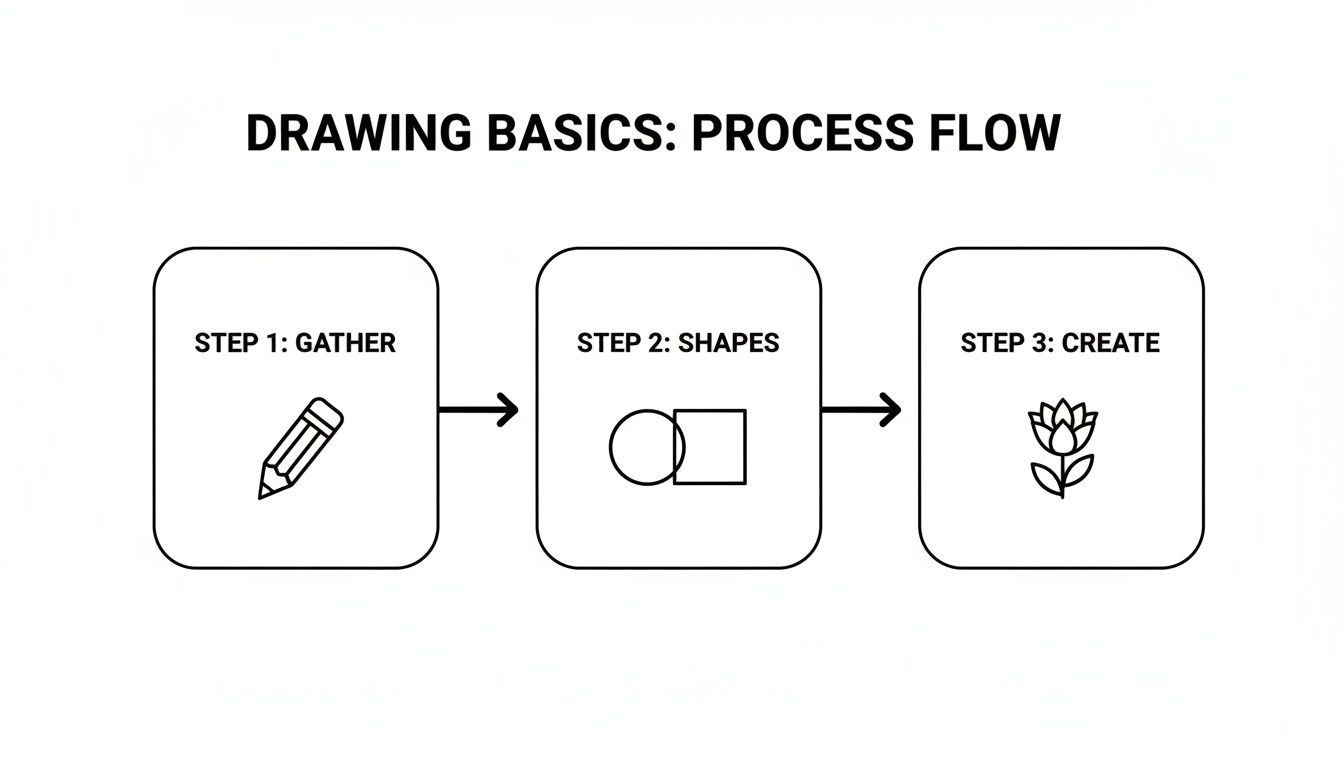
When you look at it this way, a blank page feels a lot less intimidating. It just becomes a simple, step-by-step project.
The Classic Daisy
From my experience, the daisy is the perfect flower to start with because it’s so forgiving. First, pop a small circle right in the middle of your paper—that's the center of the flower.
Now, draw long, skinny "U" shapes all the way around that center circle. These are your petals! I find that anywhere between 8 to 12 petals gives you a nice, full-looking daisy. Finish it off with a slightly curved line for the stem and add a simple leaf or two. Easy!
Coloring Advice: For that timeless daisy look, color the center a sunny yellow and leave the petals white. Practical example: to make the white petals really stand out, color the background a light blue with a crayon, then go over your pencil lines with a fine black marker. This creates a crisp, clean look.
The Elegant Tulip
To get started on a tulip, draw a large "U" shape. This forms the main cup of the flower. Next, draw a gentle, wavy line right down the middle of the "U," which gives the illusion of overlapping petals. From there, just add two pointy tips at the top, one on each side of that center line.
Give it a nice, strong stem and a long, slender leaf reaching up beside it. If you get into a groove drawing greenery, you might want to check out our guide on how to draw a plant for more inspiration.
Coloring Advice: Tulips are fantastic because they come in every color imaginable. Practical example: Try using two shades of the same color—say, a light pink and a darker magenta colored pencil. Fill in the main cup with the lighter shade, then add a touch of the darker one near the bottom and along the overlapping lines. This simple shading technique instantly gives it a rounder, more three-dimensional feel.
The Simple Rosebud
A fully bloomed rose can be a real challenge, but a rosebud is wonderfully simple. Start by drawing a small, tight spiral in the center, almost like a tiny snail shell. This little spiral is the heart of your bud.
Next, gently wrap a few curved, "C"-shaped lines around the spiral. Make each new "C" a little bigger than the last one, as if the petals are just beginning to unfurl. All that's left is to attach a stem—maybe with a small leaf and a thorn or two to give it some character.
Here's something I always remind myself: nature is perfectly imperfect. Wobbly lines and uneven petals often make flower drawings feel more authentic and charming. Don't stress about making every single curve exact.
The Whimsical Cartoon Flower
When it comes to cartoon flowers, the only rule is to have fun with it. Draw a nice big circle and give it a happy smiley face inside. Then, surround the face with five or six big, puffy, rounded petals. The goal here is bold and friendly.
Instead of a straight stem, a fun, wiggly line is perfect for that cartoon look. Finish it off with a couple of big, round leaves to match the playful vibe.
Coloring Advice: This is your chance to go wild! Bright markers work especially well for this style. Practical example: Think purple petals with a yellow face and a lime green stem. Or why not make every petal a different color for a one-of-a-kind rainbow flower? You could even add white gel pen highlights on the petals and face to make it look shiny and extra cheerful.
Why Drawing Flowers Helps Kids Grow
Drawing is so much more than a simple way to pass the time—it's a surprisingly powerful tool for a child's development. When kids draw easy flowers, they aren't just doodling. They're actively building crucial skills that will support them in school and everyday life.
Each stroke of a pencil or crayon is a step in their growth.
This creative act also connects children to the natural world in a very real, tangible way. It turns out that hands-on art is a big deal for building this connection. Recent findings actually showed a significant drop in children’s ability to accurately draw plants after school closures, highlighting a genuine learning gap.
Their drawings before the closures showed 20-30% higher detail in things like petals and leaves compared to those made after. It’s a fascinating look into how art and nature education are intertwined.
Building Skills Beyond the Page
Every time a child grips a crayon to sketch out a petal or a stem, they’re strengthening the small muscles in their hands and refining their control. This is the foundation for developing the fine motor skills they need for everything from writing letters to buttoning a shirt and tying their shoes.
If you're looking for more ways to support this, check out our guide on how you can help a child improve fine motor skills through all sorts of fun activities.
Beyond the physical benefits, drawing flowers also nurtures some vital cognitive abilities:
- Sharpened Concentration: Following the steps to create a tulip or a daisy takes focus. It teaches kids to pay attention to details and see a task through from start to finish.
- Boosted Self-Confidence: There's a special kind of pride that comes from creating something from scratch. Finishing a drawing and being able to say, "I made this!" is a huge confidence booster.
By offering a structured yet creative outlet like drawing, we give kids a safe space to express themselves. They get to make decisions about colors and shapes and watch their own ideas come to life on paper.
Giving them printable coloring pages can offer a perfect blend of structure and freedom, supporting both their artistic journey and their development. It’s a simple way to reinforce their understanding of nature while letting their creativity bloom.
Bringing Your Floral Art to Life with Color
Once your lines are on the page, the real fun begins. It's time to add color! This is the step where a simple sketch blooms into a vibrant piece of art, full of personality and life. Picking the right coloring tools for the job can make a huge difference in the final look.
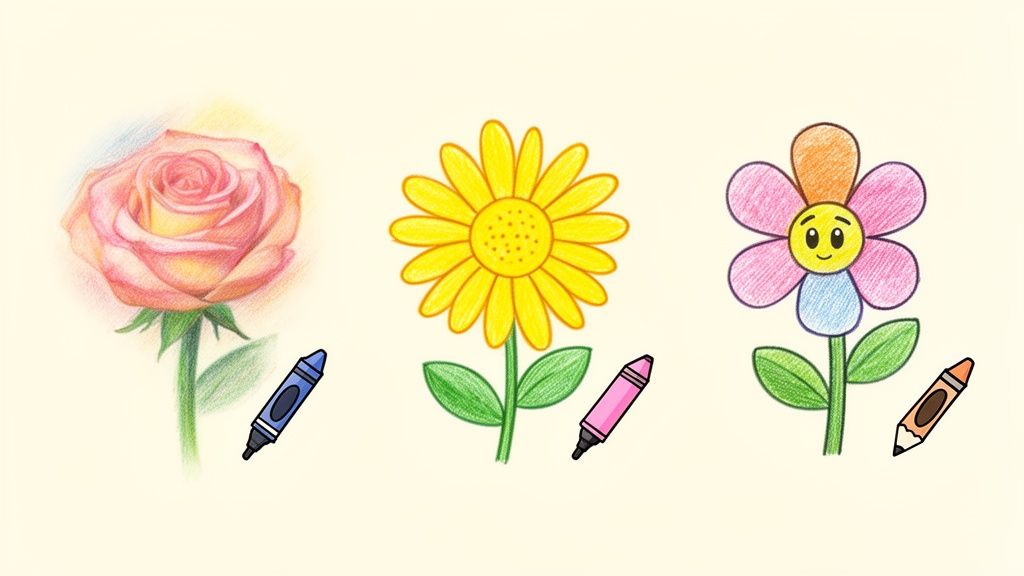
Think about crayons, for example. Their waxy texture is perfect for creating the soft, blended petals of a rosebud. You can easily layer light and dark shades to give the flower a gentle, almost three-dimensional feel. Markers, on the other hand, are fantastic for cartoon flowers. Their bold, solid colors will make that smiley face pop right off the page!
Coloring is so much more than just filling in shapes; it’s a huge part of a child's development. Did you know that kids' drawings of flowers often symbolize self-affirmation? One analysis even found that flowers appeared in 100% of sampled enrollment drawings. And in places like the UK and Australia, where 70% of parents are actively looking for screen-free activities, coloring simple flowers can boost school readiness by as much as 25%.
Making Your Colors Pop
Want to make your flower the star of the show? A little thought about the background can go a long way. You don’t need to be a professional artist to use a few simple color theory tricks to elevate your art.
- Warm vs. Cool: Practical example: Try placing a warm-colored flower, like a bright yellow daisy or a red tulip, against a cool-colored background like a blue sky or green grass. The contrast immediately draws your eye to the flower.
- Light vs. Dark: Actionable insight: Shading is your secret weapon. Simply using a slightly darker shade of the same color at the base of the petals adds instant depth. For a rose, you could use a medium pink for the main petals and a darker pink for the areas where petals overlap to make the flower look much more realistic.
The best advice I can give is to just experiment. Try mixing colors you wouldn't normally pair together, layer different tools like crayons over markers, and see what happens. Creativity has no rules!
To get more comfortable with your palette, an essential color mixing chart can be a fantastic guide. For even more fun ideas and practical tips on color combinations, check out our guide on how to teach kids colors.
Creative Ways to Use Your Finished Flower Art
So, you've got a beautiful collection of flower drawings piling up. Don't just stick them on the fridge! Now the real fun begins. Those lovely blooms are the perfect launchpad for all sorts of new craft projects.
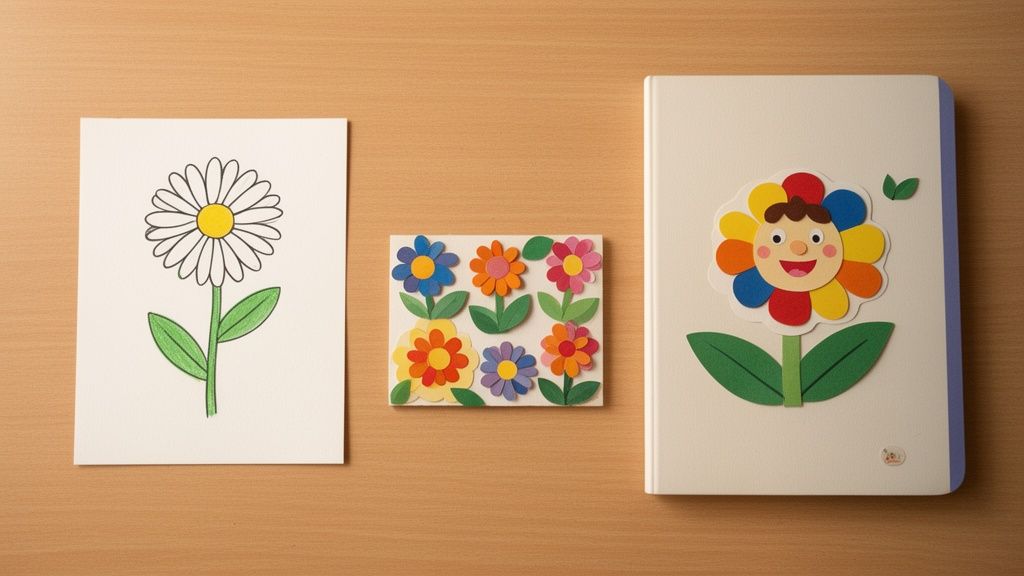
Think beyond that single sheet of paper. Each drawing can easily become a heartfelt, one-of-a-kind greeting card for a birthday or a sweet thank you note for a friend. It’s a wonderful way to turn their art into a meaningful gift.
It's also fascinating how this creative process can offer a little window into a child's world. One detailed study I came across found that kids in certain school environments drew 1.5 times more plant varieties and added far more detail to the blooms. It just goes to show how much their surroundings can shape their art. If you're curious, you can read more about these insights into children’s artistic details.
From Paper to Project
Ready for some inspiration? Here are a few simple, actionable ideas I love for giving those flower drawings a new life and celebrating your little artist's work.
- Make a Garden Collage: Get the scissors out! Practical example: Cut out about 10-15 of their flower drawings and arrange them on a large blue piece of poster board to look like a sky. Use green construction paper to cut out hills and stems, creating a vibrant indoor garden that will brighten up any bedroom wall.
- Personalize School Gear: A little clear packing tape or contact paper goes a long way. Let them decorate plain notebooks, binders, or pencil cases with their floral art for a custom look that’s all their own.
- Build a Classroom Flower Field: This one's great for teachers. Collect flower drawings from every student and create a collaborative "field of flowers" on a bulletin board. It’s a fantastic way to showcase everyone's unique style and build a sense of community.
Got Questions About Drawing With Kids? We've Got Answers
Stepping into an art project with a little one can feel like venturing into the unknown. You've got the paper, you've got the crayons, but what happens next? Let's tackle some of the common questions I hear from parents all the time.
What Are the Best Supplies for Little Hands?
When you're just starting out, keep it simple. The goal is fun, not a fine art masterpiece! I always recommend chunky crayons, fat washable markers, and big sheets of paper. They're much easier for small, developing hands to grip and control, which cuts down on frustration.
If you're looking for more specific ways to support your child's fine motor development, there's some great information out there on understanding pencil grips and choosing the right tools for their stage.
How Do I Keep Them From Getting Frustrated?
It's bound to happen: the drawing doesn't look exactly like the one in their head, and suddenly, the fun is over. When those little storm clouds gather, the best thing you can do is pivot the focus away from the outcome and onto the process.
Celebrate the effort, not just the result. Try saying things like, "Wow, I love the bright red you chose for that petal!" or "You made that stem so long and strong!" It builds their confidence and teaches them that the joy is in the doing.
Another trick I love is to draw right alongside them. I'll even make my own "oops" moments on purpose to show them that mistakes are just part of the fun and not a big deal.
What Age Is Right for These Flower Drawings?
Kids can start learning to draw easy flowers much earlier than you might think. Even a three or four-year-old can master the simple circles and lines needed for a basic daisy.
Our tutorials are designed to grow with your child. Younger kids can stick to the first few steps, while older, more dextrous children can dive into the finer details on the tulips and roses. It's all about matching the project to where they are right now.
Ready to put these tips into action? At Colortada, we offer hundreds of free, printable coloring pages that are perfect for your next creative afternoon. Find your favorite at https://www.colortada.com.