
Math coloring pages are a fantastic tool I've used for years, both in the classroom and at home. They're essentially worksheets that brilliantly merge math problems with a fun color-by-number activity. Kids solve the problems, and each answer directs them to use a specific color to fill in a part of a picture. This simple twist turns what could be a mundane drill into a genuinely creative process.
The Creative Way to Master Math Skills
Let's be honest: getting kids fired up about math practice can be a real struggle. I've seen it time and time again. This is exactly where math coloring pages shine. They take routine practice and transform it into a creative adventure.
The idea is simple but incredibly effective. You're combining the logical, step-by-step nature of math with the free-flowing creativity of coloring. This approach is a game-changer for easing math anxiety because the main goal shifts from just "getting the right answer" to completing a cool visual project.
Why Combining Math and Art Just Works
The magic lies in the instant visual feedback. When a child solves a set of problems correctly, a part of the picture suddenly comes to life with the right color. It creates this wonderfully satisfying loop that keeps them motivated and engaged. They want to see the final image!
This method does more than just make math practice less of a chore. It visually reinforces concepts, helping students build a bridge between abstract numbers and a tangible, colorful outcome. It’s a low-pressure way to build confidence and develop those crucial problem-solving skills.
Think about it in practice. A first-grader might be solving simple addition problems like "2+3" to figure out which parts of a dinosaur should be green. At the same time, a fifth-grader could be tackling fraction problems to uncover the hidden colors of an intricate space scene. This inherent adaptability is what makes them such a valuable tool across so many different age groups. This hands-on, rewarding style of engagement is a core component of play-based learning, which has proven benefits for children's development.
To give you a better idea of how you can use these pages, here’s a quick guide I've put together based on my experience.
Math Coloring Activities By Grade Level
This table breaks down how you can match different math coloring activities to specific grade levels and what they're learning.
| Grade Level | Math Concept | Example Activity |
|---|---|---|
| Preschool | Number Recognition (1-10) | Color the sections marked with a '4' blue and '5' yellow to reveal a sun. |
| Kindergarten | Basic Addition/Subtraction | Solve "1+2" and color the area with the answer '3' red. |
| 1st Grade | Addition/Subtraction (up to 20) | A picture of a robot where parts are colored based on sums like "12+5" or "18-4". |
| 2nd Grade | Double-Digit Addition | Color a landscape by solving problems like "25+15" and "40+22". |
| 3rd Grade | Multiplication/Division Facts | A "color by product" worksheet where "6x7" means coloring a section purple. |
| 4th Grade | Fractions & Decimals | Reveal an animal by coloring sections based on equivalent fractions (e.g., all 1/2 sections are green). |
| 5th Grade | Multi-Step Problems & Order of Operations | A complex mosaic pattern where each color is tied to solving an equation like "(3+5) x 2". |
As you can see, the possibilities are pretty endless and can be easily tailored to whatever skill you're trying to reinforce.
A Growing Educational Trend
Infusing art into learning isn't just a gimmick; it’s a strategy backed by results. Around the mid-2010s, educational publishers really started pushing math coloring as a way to boost numeracy skills. The numbers speak for themselves—downloads for these worksheets shot up by over 50% globally between 2015 and 2020. Research suggests this isn't a fluke; art-based math activities can improve cognitive retention by as much as 40%.
The versatility of these pages is what makes them a staple. They cover everything from basic number recognition for preschoolers to multi-step equations for middle schoolers. If you're looking for more ways to engage your kids, you can explore other learning resources that build on these same principles.
How to Choose the Right Math Coloring Pages
Let's be honest, not all math coloring pages are created equal. Finding the perfect one isn't just about picking a cute design; it’s about making a smart choice that actually boosts learning without killing the fun. A great worksheet can hook a reluctant student, but the wrong one can just lead to frustration.
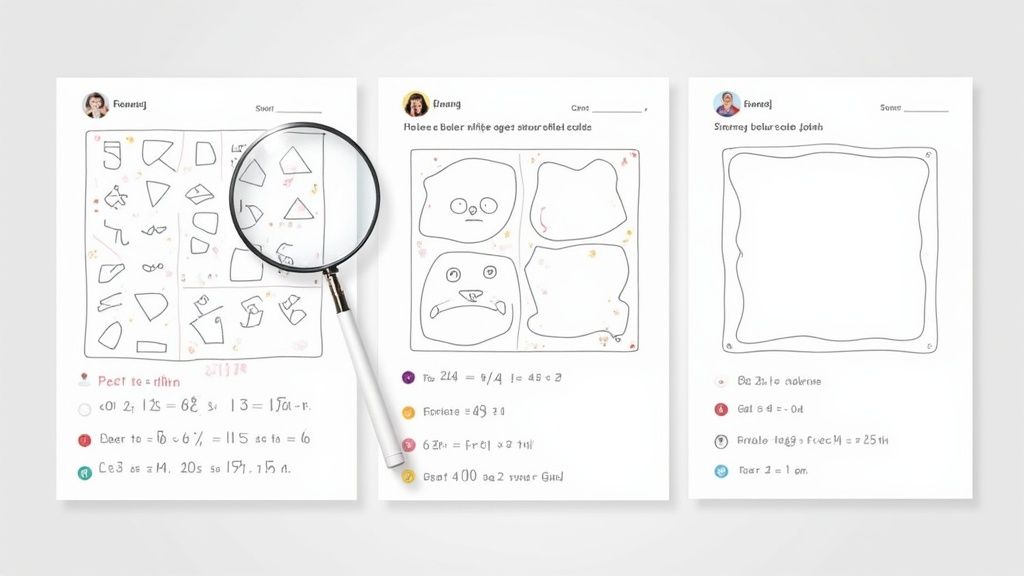
Before you hit "print," a quick check of a few key things can make all the difference, ensuring the activity is both productive and positive.
Align the Math with Learning Goals
First things first: the math has to match the child's current skill level. If it's too easy, it just becomes a coloring activity where the math is an afterthought. But if it’s too hard, you risk creating anxiety and knocking their confidence.
Actionable Insight: Look for pages that reinforce what’s being taught right now in class or focus on concepts that just need a little extra practice. For example, if your third-grader is getting the hang of multiplication, a "color by product" page is perfect. But if they're still shaky on double-digit addition, throwing multiplication at them will only backfire.
Evaluate Problem and Coloring Complexity
Next up, take a look at the complexity of both the problems and the picture. These two elements need to be in balance to keep a child engaged without feeling overwhelmed. A worksheet packed with multi-step equations and an incredibly intricate design is probably too much for a single sitting.
Here’s my mental checklist:
- Clear Instructions: Can a child figure out what to do without needing constant help? The color key should be simple to read and follow.
- Manageable Problem Set: Is the number of problems reasonable? I find that 15-25 problems is often the sweet spot for keeping kids focused.
- Appropriate Design Detail: Younger kids do best with big, simple areas to color. Older kids might appreciate more detail, but the final image should still be clear and satisfying to reveal.
An effective math coloring page finds the perfect balance. The math should be challenging enough to require thought, and the coloring should feel like a rewarding break, not another difficult task.
Choose Themes That Spark Interest
Never, ever underestimate the power of a good theme. This is where you can really connect the activity to a child’s personality. A student obsessed with superheroes will be way more motivated to solve equations if it reveals their favorite character.
Lots of websites offer an amazing variety of themes. You can find tons of general printable coloring pages that you can easily adapt for math practice. For some high-quality inspiration, check out some of the best sites for printable colouring pages and see what sparks an idea.
Practical Example: Think about what your child or students are into right now—animals, video games, fantasy creatures, you name it. Using that interest makes the worksheet feel less like homework and more like a puzzle created just for them. For a dinosaur lover, a T-Rex revealed by solving subtraction problems is a huge win.
Turning a Worksheet Into an Engaging Lesson
Having the perfect math coloring page is a great start, but the real magic is in how you bring it to life in the classroom. With a little creative framing, you can transform a simple worksheet into a lesson kids actually get excited about. The key is to build it up as a creative challenge, not just another set of math problems.
Actionable Insight: Instead of just passing out the papers, create a little buzz. Hold one up and say something like, "Alright everyone, today we're going on a mission. We have to solve these math puzzles to unlock the secret colors needed to reveal a hidden picture of a rocket ship!" Right away, the math becomes the key to unlocking the fun part—the art.
First Math, Then Art
One rule I never break is "solve before you color." I have students work through all the problems first with just a pencil. This keeps their focus right where it needs to be: on the math concepts we’re practicing. The coloring isn’t just a fun little extra; it’s the reward they earn for all that hard work and concentration.
This method also has a built-in, low-stakes way for kids to check their work. If a calculation is off, they won't accidentally start coloring a section the wrong color. It saves them the frustration of trying to erase crayon or marker, which keeps the whole experience positive.
I've found the most successful lessons treat the coloring as the grand prize. By making them complete the math first, you build anticipation. The art becomes a direct result of their problem-solving, which really reinforces the value of their effort.
Once the math is double-checked and complete, the creative floodgates can open. This is the perfect time to share a few quick tips to help them create a final piece they'll be genuinely proud of. A beautiful finished product does wonders for their confidence.
Practical Coloring Advice for a Masterpiece
Not every student feels like an artist, but a few simple pointers can make a world of difference in how their math coloring pages turn out. Sharing these tips helps sidestep common frustrations and ensures the final picture is something they're excited to show off.
Here are a few tricks I always share with my class:
- Outline First: Before you fill in a big space, trace the inside edges with your crayon. This creates a neat little border that makes it so much easier to stay in the lines.
- Light Colors in Tight Spots: For those tiny, detailed sections, I suggest using lighter colors like yellow or light blue. Dark colors like purple or black can easily bleed over the lines and smudge the whole design.
- Color in One Direction: Try to make all your coloring strokes go in the same direction—either all up-and-down or all side-to-side. It’s a simple trick that makes the final picture look incredibly tidy and polished.
These small bits of guidance give students a real sense of ownership and accomplishment. You can find some fantastic pages to try these techniques on, especially in collections of educational worksheets for kindergarten, which usually have big, bold designs that are perfect for young hands.
Reviewing the Finished Artwork
The lesson isn't over just because the last section is colored in. The final, and arguably most important, step is to review their finished artwork together. This is a wonderfully casual and visual way to circle back and reinforce the math concepts we started with.
I love to walk around the room, admiring their masterpieces and asking questions that tie the art back to the math. I might point to a picture and say, "Wow, I love that you colored the astronaut's helmet blue! What was the answer to the problem that told you to use blue?" It’s a simple, conversational review that makes the learning stick.
How to Adapt Coloring Activities for Every Learner
What I love most about math coloring pages is just how flexible they are. A single worksheet can be tweaked to fit a huge range of skill levels, which is key to making sure every child feels challenged but not overwhelmed. It's all about ditching the one-size-fits-all mentality and creating a learning experience that feels just right for them.
When you adapt the activity, you prevent the frustration that can shut down a struggling student and the boredom that makes an advanced kiddo check out. With just a few simple adjustments, you can make one activity work for your entire class.
Making It Work for Early Learners
For the little ones—preschoolers and kindergarteners—keep it simple. We’re focused on the building blocks here: number recognition, counting, and the most basic addition.
- Go for bold designs. Find worksheets with big, clear spaces to color. Tiny, intricate patterns are just frustrating for small hands that are still mastering fine motor control.
- Simplify the math on the fly. If a worksheet has double-digit problems, just cross them out and write in simple sums like "2+1." You can even just write single numbers and turn it into a number recognition hunt.
- Offer a little scaffolding. If a child seems overwhelmed, solve the first one or two problems with them. This little bit of support builds their confidence and shows them exactly what to do next.
Stretching Your Advanced Students
On the flip side, you’ve got students who are ready for more. The goal isn’t just to give them more work; it’s to add layers of complexity and critical thinking to the same worksheet.
This three-step flow shows how to keep the learning structured and effective.
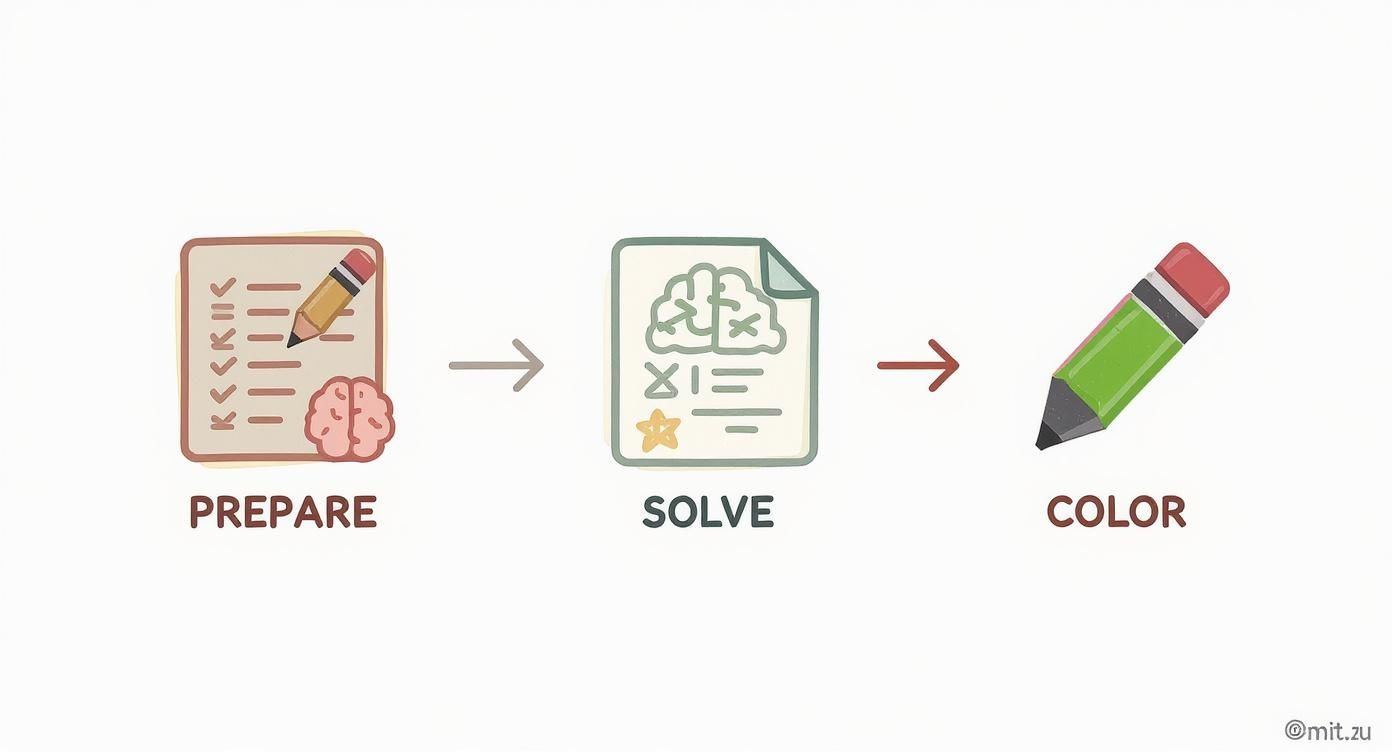
By preparing, solving, and then coloring, the math always stays front and center.
Here are a few ways I like to challenge older or more advanced students:
- Let them create a new color key. Challenge them to write their own problems for the existing answers. If the answer ‘15’ is blue, they could come up with a new problem like “(5 x 4) - 5” that also equals 15.
- Introduce multi-step problems. Instead of simple multiplication, ask them to write and solve a two-step equation for each color section.
- Bring in fractions and decimals. You can take a standard whole-number worksheet and have them convert the answers into fractions or decimals before they find the right color.
The real power of differentiation is making sure every student is working in their "zone of proximal development"—that sweet spot where the task is not too easy and not too hard. A small tweak to a math coloring page can achieve this perfectly.
By thinking creatively, you can turn a simple resource into a powerful tool that meets every learner right where they are. This is what makes math coloring pages a go-to for any educator or parent who wants to provide meaningful practice that feels more like fun than work.
Creative Math Coloring Projects Beyond the Worksheet
A single math coloring page is great for practice, but why stop there? You can take this simple idea and scale it up into a big, collaborative project that gets the whole class involved. These activities are fantastic because they shift the focus from individual work to a shared accomplishment, giving students a real sense of ownership that a regular assignment just can't match.
We're essentially moving from a quiet, heads-down task to a buzzing, group-oriented event.
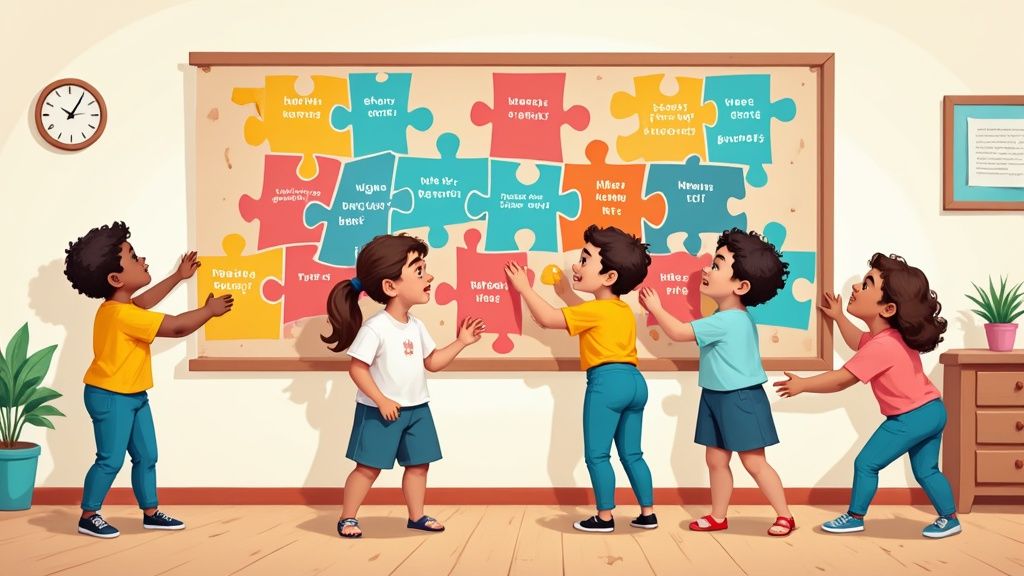
This approach isn't just a gimmick; it taps into the same cognitive principles that have made coloring so popular everywhere. The global market for adult coloring books, which often feature similar designs, hit around USD 150 million in 2023 and is expected to more than double by 2031. It’s clear people love activities that mix mindfulness with a mental workout, and bringing that into a group setting in the classroom just amplifies the benefits. You can see the full breakdown of these market trends over at Verified Market Research.
Create a Collaborative Math Mural
One of my all-time favorite projects is the collaborative math mural. It’s pretty simple to set up. Start by finding a large, complex coloring image online—you can usually find them by searching for "classroom poster" or "collaborative coloring puzzle."
Print the image out in sections, so each student gets one piece of the bigger picture. Each individual piece has its own set of math problems to solve.
Actionable Steps:
- Assign Sections: Give each student one piece of the mural with its unique math problems.
- Solve and Color: Students solve the problems on their sheet to determine the correct colors.
- Assemble the Masterpiece: The class works together to assemble all the colored pieces on a bulletin board, and slowly, the full, vibrant mural comes to life.
This project is so effective because it physically shows students how their individual contributions fit into a greater whole. A small square of correctly solved multiplication problems suddenly becomes a critical part of a massive, colorful dragon or a detailed map of the solar system.
Host a Math Art Gallery
Another project that gets kids really excited is a "Math Art Gallery." Give students a week or so to complete a particularly detailed math coloring page. The key here is to encourage them to treat it like a real piece of art, not just another worksheet. I like to give them a few specific tips to make their work pop.
Coloring Advice for the Gallery
- Create Texture: Show them how to use cross-hatching (making crisscross lines) or stippling (making tiny dots) with colored pencils. It adds amazing depth to larger areas.
- Blend for Effect: A great trick is blending two similar colors, like a light blue and a dark blue, to create a smooth gradient. This works beautifully for things like skies or water.
- Choose a Consistent Palette: Suggest they stick to a limited or complementary color scheme. It helps their final piece look more polished and intentional.
Once the masterpieces are complete, display them around the classroom. Then, you can hold a "gallery walk" where students can admire each other's work. I also have students stand by their art and explain the math concepts behind their piece to classmates who "visit" their station. It’s a brilliant way to reinforce learning through peer-to-peer teaching and celebrate their hard work.
Answering Your Questions About Math Coloring Pages
Even with all the clear benefits, it's natural to have a few questions before you dive in. Over the years, I've heard some great ones from parents and fellow teachers, so let's clear up the most common ones to help you get started on the right foot.
How Do I Keep the Focus on the Math?
This is probably the question I get asked most often. It’s easy to worry that the fun of coloring will overshadow the actual math practice. My golden rule is simple: all math problems must be solved first.
Practical Tip: Have children use a pencil to write the answer directly inside each section before they even pick up a crayon. This creates a quick visual check for you and reinforces the connection between the problem and the space they're about to color. Once the math is checked, they get the green light to bring the picture to life.
Are These Worksheets a Good Fit for Every Age?
They absolutely are, and that’s the real magic of them. The trick is simply to adjust the complexity to the child's level.
- For preschoolers, the "math" might just be recognizing numbers and shapes. For example, "Color all the number 3s green."
- For older students, the problems can scale up to multiplication, fractions, or even introductory algebra. For example, "Color all sections where x=5 for the equation 2x+1 red."
The key is matching both the math concepts and the coloring design to the student’s developmental stage. A sheet with tons of tiny, intricate sections would just frustrate a kindergartener, but it could be the perfect challenge for a detail-oriented fifth-grader.
The real secret to making these pages work is to treat them as a two-part activity. First comes the focused, problem-solving session. Then comes the rewarding and relaxing creative session. Separating the two keeps both parts of the activity meaningful.
As long as the math aligns with what they're currently learning and the art is appropriate for their fine motor skills, these activities can be a fantastic tool for just about any age.
Ready to bring a splash of color to your math lessons? Colortada offers a huge library of fun, engaging, and printable coloring pages perfect for kids of all ages. Find your next creative activity at https://www.colortada.com.