
Welcome, parents and educators, to a practical guide designed to transform playtime into a powerful engine for learning. The preschool years mark a period of extraordinary brain growth, where simple interactions and joyful exploration lay the essential groundwork for future academic success. This is when the core abilities for problem-solving, memory recall, attention, and critical thinking begin to blossom. Nurturing these skills doesn't require complex tools or rigid lesson plans; it happens naturally through purposeful, engaging play.
This article moves beyond generic advice to provide a curated roundup of 10 essential cognitive development activities for preschoolers. We will explore everything from the structural logic of block play and the creative reasoning of pretend play to the pattern recognition honed by sorting games. Each activity in this comprehensive list is broken down into actionable components, ensuring you can implement them immediately at home or in the classroom. You will find:
- Targeted Cognitive Skills: Pinpoint exactly which mental muscles each activity strengthens.
- Step-by-Step Instructions: Clear, easy-to-follow directions to get started.
- Practical Variations: Ideas to adapt activities for different settings and skill levels.
- Coloring Integration: Unique tips on using Colortada's printable coloring pages to reinforce concepts and extend the learning experience.
Prepare to discover how hands-on play can build a brilliant mind, one joyful moment at a time. This list provides the specific, actionable insights you need to support your child’s intellectual journey through meaningful, fun-filled experiences. Let's dive in.
1. Block Play and Construction
Block play is a cornerstone of early childhood education, offering a rich, hands-on experience that significantly boosts cognitive development activities for preschoolers. By manipulating materials like wooden blocks, LEGOs, or magnetic tiles, children engage in a dynamic process of creation, experimentation, and discovery. This seemingly simple play is a complex exercise in spatial reasoning, problem-solving, and foundational mathematical thinking.
Targeted Skills and Learning Goals
- Primary Cognitive Skills: Problem-solving, spatial awareness, planning, attention.
- Learning Goals: To understand cause and effect (e.g., a taller tower is less stable), to practice pre-mathematical concepts like sorting, sequencing, and symmetry, and to develop fine motor skills and hand-eye coordination.
Materials and Setup
- Materials: A variety of blocks (wooden, plastic, foam, magnetic), a flat, open play area (floor or low table), and optional props like small figurines or toy vehicles.
- Setup: Create a dedicated, accessible "construction zone" where children can build without interruption. Store blocks in low, open containers to encourage independent access and cleanup.
Step-by-Step Instructions
- Introduce the Materials: Present the blocks without specific instructions. Allow children to explore their properties: weight, shape, and how they connect or stack.
- Model, Don't Direct: Instead of telling a child what to build, sit alongside them and start building your own structure. This parallel play encourages them to experiment without pressure.
- Introduce a Challenge: Once a child is comfortable, introduce a simple, open-ended challenge. For example, "Can we build a bridge that this car can go under?" or "How tall can we make a tower before it falls?"
- Document the Process: Take photos of their creations. This validates their effort and provides a visual record they can reflect on, reinforcing concepts of design and structure.
Pro-Tip: Rotate the type of blocks available every week or two. Switching from wooden blocks to magnetic tiles, for instance, presents new engineering challenges and keeps the activity engaging.
Incorporating Colortada Coloring Pages
Reinforce the concepts learned during block play with themed coloring pages. After a building session focused on creating houses or castles, provide a Colortada architectural printable. Ask your child to color the structure using the same color patterns they used in their block creation. This bridges the gap between 3D construction and 2D representation, strengthening their spatial understanding and creative expression.
Coloring Advice: Encourage them to use bold, solid colors for the main structure, just like solid blocks, and add details like lines or dots for windows and doors. This teaches them to differentiate between foundational shapes and decorative elements.
2. Pretend Play and Role-Playing
Pretend play, or role-playing, is a powerful engine for learning and one of the most essential cognitive development activities for preschoolers. When children step into roles like a doctor, a chef, or a parent, they are not just having fun; they are actively constructing their understanding of the world. This imaginative play allows them to explore social roles, practice language, and navigate complex emotional scenarios in a safe, controlled environment.
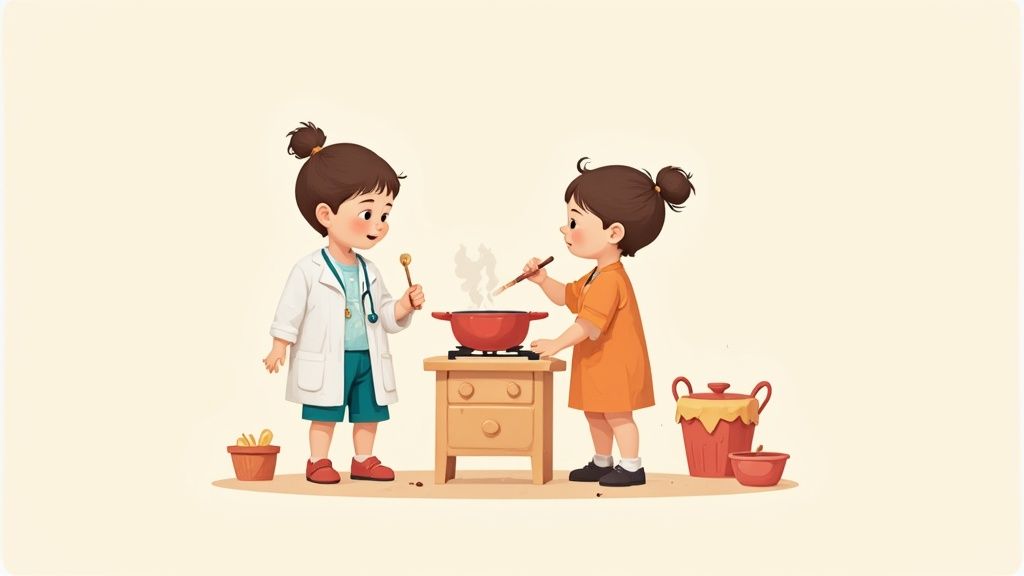
Targeted Skills and Learning Goals
- Primary Cognitive Skills: Executive function, symbolic thinking, language development, emotional regulation.
- Learning Goals: To develop empathy and perspective-taking (theory of mind), to practice problem-solving in social contexts, and to build vocabulary and narrative skills by creating and acting out stories.
Materials and Setup
- Materials: Themed props (e.g., doctor kit, toy food, cash register), costumes or dress-up clothes, and a designated play area. Open-ended items like cardboard boxes and fabric scraps also work wonderfully.
- Setup: Create a specific "dramatic play center" that can be transformed. Start with a familiar theme like a home kitchen or a grocery store. Keep props organized in labeled bins to encourage children to set up and clean up independently.
Step-by-Step Instructions
- Introduce a Scenario: Read a book or talk about a recent experience, like a visit to the doctor's office. This provides a foundation and context for the play.
- Provide Open-Ended Props: Offer materials and let the children lead the narrative. Instead of directing, ask open-ended questions like, "It looks like your teddy bear has a cough. What should we do?"
- Model and Participate: Join in the play by taking on a role yourself. If they are running a restaurant, be a customer. This validates their imaginative world and allows you to model social interactions and vocabulary.
- Rotate Roles and Themes: Encourage children to switch roles, allowing everyone a chance to lead and follow. Change the theme of the play center every few weeks (e.g., from a post office to a veterinary clinic) to introduce new concepts and vocabulary.
Pro-Tip: Introduce a "problem" for the children to solve within their play. For example, in a pretend café, you might say, "Oh no, we're all out of bananas for the smoothie!" This prompts creative thinking and collaboration.
Incorporating Colortada Coloring Pages
Extend the imaginative experience with coloring. If the day's play involved a trip to a pretend zoo, offer a Colortada animal printable. Encourage your child to color the lion and then create a story about its day at the zoo, perhaps acting it out with the finished picture. This activity connects their dynamic, active play with the focused, creative task of coloring, strengthening narrative skills and fine motor control.
Coloring Advice: Suggest using colors that represent the animal's mood in their story. A happy lion might be a bright, sunny yellow, while a sleepy lion could be a calm, cool blue, helping them connect colors to emotions.
3. Puzzle and Sorting Activities
Puzzle and sorting activities are foundational cognitive development activities for preschoolers that encourage children to observe, compare, and categorize the world around them. Whether fitting a wooden piece into its correct spot or grouping buttons by color, these hands-on tasks are powerful exercises in logic, pattern recognition, and visual discrimination. This focused play builds critical thinking pathways and enhances a child's ability to make sense of complex information.
Targeted Skills and Learning Goals
- Primary Cognitive Skills: Logical reasoning, pattern recognition, visual-spatial awareness, classification.
- Learning Goals: To identify attributes like color, size, and shape; to understand part-to-whole relationships; to develop persistence and problem-solving strategies; and to refine fine motor control and hand-eye coordination.
Materials and Setup
- Materials: A variety of puzzles (knob puzzles, chunky puzzles, simple jigsaws), an assortment of small objects for sorting (buttons, pom-poms, leaves, pasta shapes), and containers like sorting trays, bowls, or an egg carton.
- Setup: Designate a quiet, well-lit area with a flat surface like a mat or low table. Store puzzles and sorting kits in clear, labeled containers on low shelves to empower children to choose their own activities and practice cleanup.
Step-by-Step Instructions
- Start Simple: Introduce a puzzle with only 4-6 large pieces, preferably with knobs for easy gripping. For sorting, begin with a single attribute, such as sorting red and blue pom-poms into two separate bowls.
- Demonstrate the Process: Sit with the child and think aloud as you work. Say, "This puzzle piece is round, so I'm looking for a round hole," or "This button is yellow, so it goes in the yellow pile."
- Increase Complexity Gradually: As they master simple tasks, introduce puzzles with more pieces or sorting activities with multiple attributes. For example, ask them to sort objects by both size and shape (e.g., "Find all the small, square blocks").
- Use Real-World Objects: Move beyond manufactured toys. A basket of different leaves from the backyard or a collection of various pasta shapes makes for an engaging and tangible sorting challenge.
Pro-Tip: Turn cleanup into a learning game. Sorting the mixed-up puzzle pieces or categorizing the different art supplies back into their correct bins reinforces classification skills in a practical, everyday context.
Incorporating Colortada Coloring Pages
Extend the learning from a sorting session with a related coloring activity. After sorting objects by type, provide a Colortada "Things That Go" printable featuring cars, planes, and boats. Instruct your child to color all the cars one color, all the boats another, and all the planes a third. This activity reinforces categorization and strengthens the connection between concrete objects and their 2D representations.
Coloring Advice: Encourage them to stay within the lines for each category. This focused effort reinforces the concept of distinct groups and improves fine motor precision, a skill directly related to fitting puzzle pieces correctly.
4. Nature Exploration and Outdoor Play
Nature exploration is a powerful sensory-rich experience that serves as one of the most effective cognitive development activities for preschoolers. By interacting with the natural world, children engage their curiosity, develop keen observational skills, and begin to form a foundational understanding of scientific concepts. This hands-on investigation of plants, insects, weather, and textures stimulates critical thinking and fosters a deep connection to the environment.
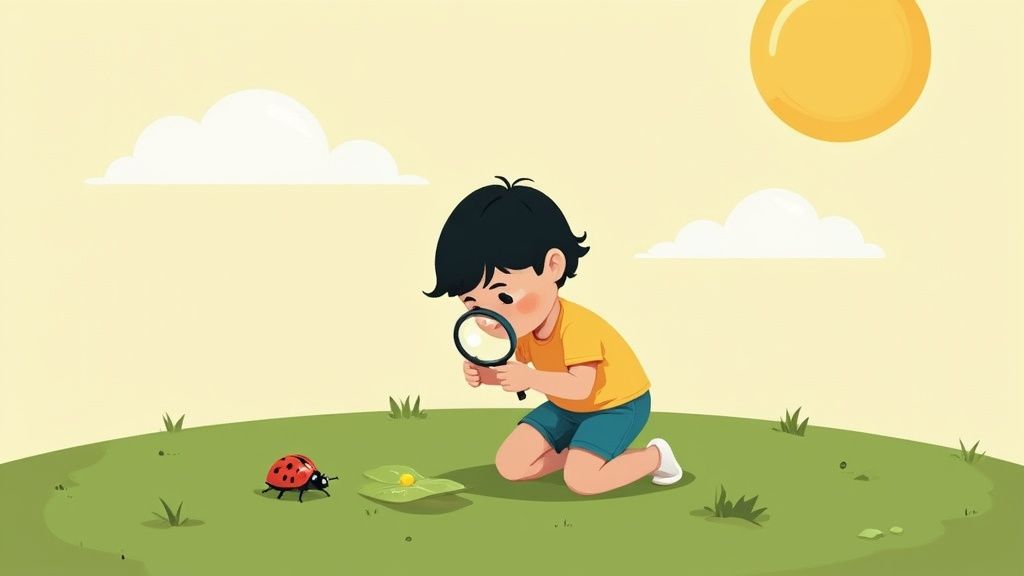
Targeted Skills and Learning Goals
- Primary Cognitive Skills: Observation, curiosity, problem-solving, categorization.
- Learning Goals: To develop scientific inquiry skills (asking questions, making predictions), to understand natural cycles and ecosystems, to enhance sensory processing, and to practice classifying objects based on attributes like size, color, and texture.
Materials and Setup
- Materials: A "nature exploration kit" including a magnifying glass, bug viewer, small containers or bags for collecting, and a notebook for sketches. Optional: child-friendly field guides for local plants and insects.
- Setup: A safe outdoor area is all that is needed, whether it's a backyard, a local park, or a hiking trail. The key is to allow unstructured time for discovery within set boundaries.
Step-by-Step Instructions
- Prepare for Discovery: Assemble the nature exploration kit and discuss its purpose. Talk about being respectful observers of nature, emphasizing gentle handling of creatures and plants.
- Go on a "Noticing" Walk: Begin by simply walking and encouraging the child to point out anything they find interesting. Use open-ended prompts like, "What do you see on that leaf?" or "How does that bark feel?"
- Focus on an Element: Introduce a specific task, such as a bug hunt or a rock collection. Use the magnifying glass to examine details and the containers to gather interesting, non-living items like uniquely shaped leaves, acorns, or stones.
- Sort and Discuss Findings: Back at home or in the classroom, lay out the collected treasures. Guide the child to sort them into groups by color, shape, or type. Discuss where each item was found and what its purpose might be.
Pro-Tip: Visit the same natural spot during different seasons. This helps children observe and understand significant environmental changes, reinforcing concepts of life cycles, weather patterns, and adaptation.
Incorporating Colortada Coloring Pages
Extend the nature lesson indoors with themed coloring pages. After a bug hunt, provide a Colortada insect and arachnid printable. Encourage your child to recall the colors and patterns they saw on the real insects and replicate them on the page. Ask them to color the background to show the habitat where they found the bug, whether it was on a green leaf, brown soil, or a colorful flower, reinforcing their memory and observational skills.
Coloring Advice: Suggest using multiple shades of green for the background leaves or different browns for the dirt. This encourages them to observe and represent the subtle variations found in nature, moving beyond using a single color for an object.
5. Music and Rhythm Play
Music and rhythm play is an engaging and joyful activity that serves as a powerful tool for cognitive development activities for preschoolers. By participating in activities like singing, dancing, and playing simple instruments, children explore patterns, memory, and auditory discrimination. This form of play taps into a child's natural inclination to move and make noise, transforming it into a structured learning experience that boosts language skills, emotional expression, and social connection.
Targeted Skills and Learning Goals
- Primary Cognitive Skills: Auditory processing, pattern recognition, memory, attention.
- Learning Goals: To recognize and replicate rhythmic patterns, to enhance memory through song lyrics and sequences, to develop gross motor coordination through dance, and to foster emotional expression and social turn-taking.
Materials and Setup
- Materials: Child-safe instruments (shakers, drums, bells, xylophones), a music player or speaker, and open space for movement. Homemade instruments like rice-filled bottles or pots and wooden spoons also work perfectly.
- Setup: Designate an area with enough room for children to dance and move freely. Keep a basket of instruments accessible so children can independently select them during music time.
Step-by-Step Instructions
- Start with Body Percussion: Introduce rhythm through clapping, stomping, snapping, and patting. This helps children feel the beat in their own bodies before using an instrument.
- Use Call-and-Response: Sing a simple line or clap a short pattern and ask the children to echo it back. This builds listening skills, memory, and turn-taking. For example, "I say boom boom boom, you say..."
- Introduce Instruments: Provide a variety of instruments and allow for free exploration. Encourage children to discover the different sounds each one makes without rigid instructions.
- Connect Music and Movement: Play different types of music (fast, slow, loud, soft) and encourage children to move their bodies to match the tempo and mood. Ask, "How would a butterfly dance to this song? How would a giant stomp?"
Pro-Tip: Repeat familiar songs often. Repetition is key for preschoolers, as it builds confidence, reinforces memory, and provides a comforting structure that allows them to participate more fully.
Incorporating Colortada Coloring Pages
Extend the musical exploration with a creative art activity. After a session playing with various instruments, offer a Colortada musical instruments printable. Encourage your child to color the maracas, drums, and horns. As they color, play the sounds each instrument makes. Ask them to use "fast colors" like yellow and orange for upbeat instruments or "slow colors" like blue and purple for calming ones, connecting auditory concepts to visual representation.
Coloring Advice: Challenge them to create a visual pattern on the drum, like a sequence of red and blue stripes. This connects the auditory patterns of music with visual patterns, reinforcing the core concept of sequencing in a new way.
6. Sensory Play and Exploration
Sensory play is a powerful and engaging method for fostering cognitive growth in young children. By actively exploring materials with different textures, temperatures, and properties like sand, water, or playdough, preschoolers engage their senses to gather and process information about the world. This hands-on investigation is fundamental to scientific thinking and is one of the most effective cognitive development activities for preschoolers, building crucial neural pathways for higher-level learning.
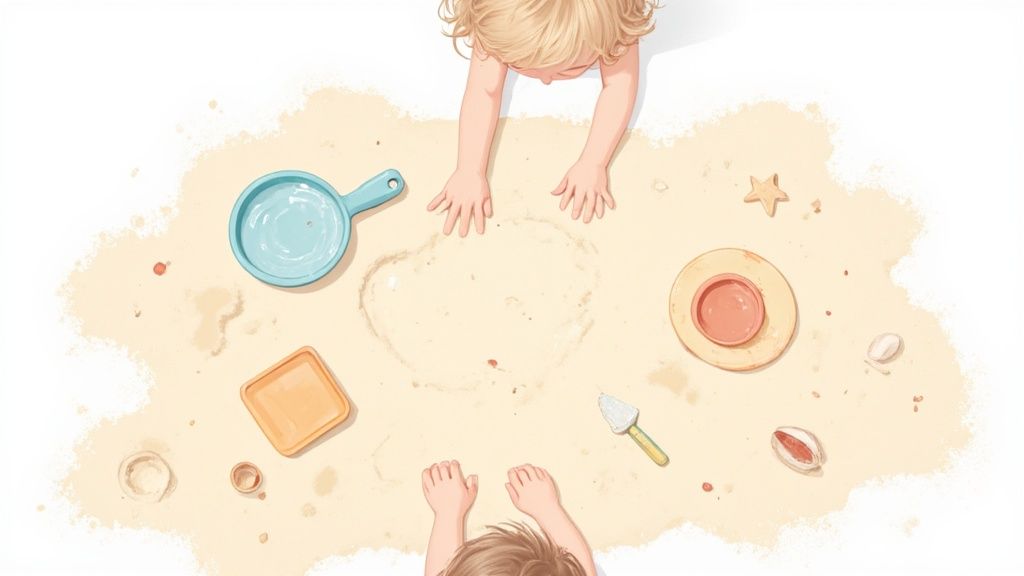
Targeted Skills and Learning Goals
- Primary Cognitive Skills: Sensory discrimination, scientific inquiry (observation, hypothesis testing), attention, problem-solving.
- Learning Goals: To classify objects based on sensory attributes (e.g., smooth vs. rough), to understand concepts like cause and effect (e.g., adding water changes sand's texture), and to develop language skills by describing sensory experiences.
Materials and Setup
- Materials: A sensory bin or water table, base materials (sand, water, dry pasta, kinetic sand, oobleck), and tools for exploration like scoops, funnels, cups, and droppers.
- Setup: Designate a specific, easy-to-clean area for sensory play. Fill a shallow bin with your chosen base material and add various tools to encourage manipulation and discovery. For more ideas on setups, you can explore these sensory activities for preschoolers on colortada.com.
Step-by-Step Instructions
- Introduce the Sensory Bin: Present the bin and allow children to freely explore the materials with their hands and the provided tools.
- Model Descriptive Language: Play alongside the child and narrate your experience. Use rich vocabulary, saying things like, "The sand feels gritty and warm," or "The water is cool and splashes when I drop the stone in."
- Pose Open-Ended Questions: Encourage scientific thinking by asking questions that prompt investigation. For example, "What do you think will happen if we add water to the dry sand?" or "Which of these items will float?"
- Incorporate Sorting: Add a new element by providing objects of different textures or colors (e.g., smooth stones and rough pom-poms) and ask the child to sort them into separate containers.
Pro-Tip: Layer different materials in your sensory bin to create a multi-sensory experience. For example, place smooth river rocks at the bottom of a water table or hide small plastic animals within a bin of colored rice for a tactile treasure hunt.
Incorporating Colortada Coloring Pages
Extend the sensory learning by connecting it to a 2D activity. After a session playing with sand and water, provide a Colortada beach scene printable. Encourage your child to color the sand using crayons for a waxy, bumpy texture and the water with markers for a smooth, fluid look. This helps them translate their tactile experiences into visual art, reinforcing sensory memory and creative expression.
Coloring Advice: Suggest they add texture to their coloring. For the sandy area, they could try making small dots with a crayon to mimic grains of sand. For the water, long, flowing strokes with a marker can represent waves. This teaches them that different coloring techniques can represent different textures.
7. Story-Based Learning and Storytelling
Story-based learning is a powerful method among cognitive development activities for preschoolers, transforming passive listening into an active, imaginative experience. When children engage with narratives through props, puppets, or flannel boards, they are not just being entertained; they are building crucial cognitive architecture for language comprehension, sequencing, and understanding cause-and-effect relationships. This activity taps into a child’s natural love for stories to foster critical thinking and emotional intelligence.
Targeted Skills and Learning Goals
- Primary Cognitive Skills: Language comprehension, narrative sequencing, memory, attention, logical reasoning.
- Learning Goals: To understand story structure (beginning, middle, end), to predict outcomes based on events, to develop empathy by relating to characters, and to enhance vocabulary and sentence construction.
Materials and Setup
- Materials: Story props (puppets, felt characters for a flannel board, small toys), picture books (especially wordless ones), a comfortable seating area. A "story sack" containing a book and related objects can be highly effective.
- Setup: Designate a cozy "story corner" with soft cushions or a small rug. Keep props organized in labeled bins or bags, making them easily accessible for both adult-led sessions and child-initiated play. A simple flannel board can be mounted on a wall or placed on an easel.
Step-by-Step Instructions
- Choose a Simple Story: Start with a familiar or repetitive story like "The Three Little Pigs." Use puppets or felt figures to represent the characters and key elements.
- Tell the Story Interactively: Use distinct voices and expressive gestures. Pause to ask predictive questions, such as, "What do you think the wolf will do next?" This encourages active listening and critical thinking.
- Encourage Retelling: After the story, invite children to retell it using the props. Don't correct them; instead, celebrate their unique interpretations. This builds confidence and reinforces their understanding of the narrative sequence.
- Prompt Story Creation: Present a set of unrelated props (e.g., a dinosaur, a key, and a boat) and encourage children to create their own original story. This nurtures creativity and advanced problem-solving skills.
Pro-Tip: Connect stories directly to children's lives. After reading a story about friendship, ask, "Who is your friend? What do you like to do together?" This makes the narrative more meaningful and strengthens social-emotional connections. The storytelling process is a core element in making learning fun and engaging.
Incorporating Colortada Coloring Pages
Extend the narrative experience by pairing it with coloring. After telling a story about animals on a farm, provide a Colortada farm animal printable. Challenge your child to color the animals as they appeared in the story or to create a new scene showing what happens after the story ends. Ask them to describe their colored scene, effectively creating a new story ending. This activity solidifies memory, encourages creative thinking, and connects oral storytelling with visual art.
Coloring Advice: Ask them to color the main character first, then the setting, and finally the other characters. This follows the natural structure of a story (introducing a character in a place) and reinforces narrative sequencing skills visually.
8. Art and Creative Expression
Art and creative expression are fundamental cognitive development activities for preschoolers, offering a powerful medium for communication, emotional processing, and intellectual growth. Engaging in open-ended activities like painting, drawing, and sculpting allows children to transform abstract thoughts into tangible forms. This process-oriented play is a vital workout for the brain, strengthening decision-making skills, visual-spatial reasoning, and symbolic thinking.
Targeted Skills and Learning Goals
- Primary Cognitive Skills: Creative thinking, problem-solving, attention, symbolic representation.
- Learning Goals: To express ideas and emotions non-verbally, to understand cause and effect (e.g., mixing blue and yellow paint makes green), to develop fine motor control, and to practice making choices and seeing them through.
Materials and Setup
- Materials: Washable, non-toxic paints, various brushes, sponges, droppers, crayons, markers, paper of different sizes and textures, collage materials (fabric scraps, yarn, buttons), and natural items (leaves, twigs).
- Setup: Designate a mess-friendly art space, like an "atelier" inspired by the Reggio Emilia approach. Use an easel or cover a table and the floor with protective sheeting. Organize materials in low, open containers so children can independently select what they need.
Step-by-Step Instructions
- Present Materials as an Invitation: Arrange a selection of materials on a table without a specific project in mind. The goal is to invite curiosity and exploration.
- Focus on Process, Not Product: Emphasize the experience of creating. Use language that encourages experimentation, such as, "I wonder what will happen if you use the sponge?" or "Tell me about the colors you are using."
- Encourage Sensory Exploration: Allow children to use their fingers to paint or to feel the texture of different collage materials. This sensory input is crucial for brain development. For more hands-on ideas, you can explore various creative art projects for preschoolers that spark imagination.
- Display All Artwork: Validate every child's effort by proudly displaying their work. This builds self-esteem and communicates that their creative expression is valued.
Pro-Tip: Introduce unconventional tools to challenge creative thinking. Instead of brushes, offer toy cars to drive through paint, salad spinners for splatter art, or bubble wrap for textured printing.
Incorporating Colortada Coloring Pages
Extend the exploration of artistic tools and mediums using coloring pages. After a session of sponge painting, provide a Colortada animal printable. Challenge your child to color the animal not with crayons, but by dabbing paint onto the page with a small piece of sponge. This activity reinforces their understanding of texture and tool usage while bridging the gap between free-form art and structured representation. You can find more family-friendly ideas in our guide to art projects for families.
Coloring Advice: Encourage color mixing directly on the page. On a printable of a sunset, for example, have them color a patch of red and then color yellow over part of it to see orange appear. This is a simple, contained way to teach primary and secondary colors.
9. Pattern Recognition and Matching Games
Pattern recognition is a fundamental skill that forms the bedrock of mathematical thinking and logical reasoning. This category of cognitive development activities for preschoolers involves identifying, creating, and extending patterns using various materials like beads, tiles, or cards. By engaging in these games, children learn to make predictions, understand sequencing, and develop a systematic approach to organizing information, all of which are crucial for higher-level thinking.
Targeted Skills and Learning Goals
- Primary Cognitive Skills: Logical reasoning, predictive thinking, sequencing, attention to detail.
- Learning Goals: To identify and create simple patterns (e.g., AB, ABC), to develop early algebraic thinking by understanding rules and relationships, and to enhance visual discrimination and problem-solving abilities.
Materials and Setup
- Materials: Colorful beads and string, LEGOs or colored blocks, dominoes, pattern cards, or natural items like leaves and shells.
- Setup: Arrange the materials on a clean, flat surface like a tray or a mat. For a focused activity, present only the materials needed for a specific pattern game to minimize distractions.
Step-by-Step Instructions
- Start Simple: Introduce a basic two-part (AB) pattern. For example, create a line of blocks: red, blue, red, blue. Say the pattern aloud as you point to each block.
- Ask for Extension: Leave the pattern unfinished and ask, "What comes next?" Encourage the child to place the next block in the sequence.
- Encourage Creation: Once the child is comfortable extending patterns, give them the materials and prompt them to create their own pattern. This shifts them from a passive role to an active creator.
- Use Body Patterns: Make it physical! Create a simple clap-stomp-clap-stomp pattern and have the child join in. This kinesthetic learning helps solidify the concept of sequencing.
Pro-Tip: Connect patterning to daily life. Point out patterns on their clothing (stripe, solid, stripe), during snack time (cracker, cheese, cracker), or in songs and rhymes. This reinforces that patterns are everywhere.
Incorporating Colortada Coloring Pages
Extend the learning from hands-on activities to 2D representation with specially designed printables. After a session of creating patterns with beads, use a Colortada geometric pattern printable. Challenge your child to color the shapes following a specific pattern they just created, such as coloring a sequence of circles red-yellow-red-yellow. This activity reinforces their understanding of pattern rules while also refining their fine motor control and color recognition skills.
Coloring Advice: Before they begin, ask them to pick two or three "pattern colors" and set only those crayons aside. This pre-planning step reinforces the concept of a rule-based system and helps them focus on executing the pattern without being distracted by too many color choices.
10. Inquiry-Based Science Play and Experiments
Inquiry-based science play transforms a child's natural curiosity into a powerful engine for learning. This approach is one of the most effective cognitive development activities for preschoolers, as it encourages them to ask questions, form hypotheses, and test their ideas through direct experimentation. Activities like exploring what sinks or floats, mixing colors, or playing with magnets are not just fun; they are foundational lessons in scientific reasoning, observation, and understanding cause and effect.
Targeted Skills and Learning Goals
- Primary Cognitive Skills: Critical thinking, problem-solving, observation, reasoning.
- Learning Goals: To develop a basic understanding of physical properties (e.g., density, magnetism), to practice making predictions and observing outcomes, and to build a foundational vocabulary for scientific concepts.
Materials and Setup
- Materials: Clear containers, water, various small objects for sink/float tests, food coloring, pipettes, magnets, metal and non-metal items, baking soda, and vinegar.
- Setup: Designate a "discovery station" or area that can tolerate spills. Arrange materials in an inviting, accessible way in low trays or bins, allowing children to choose their experiment and lead their own investigation.
Step-by-Step Instructions
- Pose an Open-Ended Question: Start with a simple, curiosity-driven question. For a sink-or-float activity, ask, "I wonder which of these things will go to the bottom of the water?"
- Encourage Predictions: Before they start, ask children to make a guess. "Do you think the leaf will sink or float? Why do you think that?" This introduces the concept of a hypothesis.
- Facilitate Hands-On Exploration: Allow the child to drop the items into the water themselves. Let them experiment freely, repeat tests, and explore without a prescribed outcome.
- Discuss the Results: Talk about what happened. Use descriptive language like, "Look, the rock sank quickly, but the plastic boat is floating on top!" This helps them connect their actions to the results and build vocabulary.
Pro-Tip: Document the experiment. Create a simple chart with pictures of the items, and have the child draw a checkmark in the "sink" or "float" column. This visual record reinforces their findings and introduces basic data collection.
Incorporating Colortada Coloring Pages
Extend the scientific discovery with a relevant coloring activity. After an experiment with plants or watching a seed sprout, provide a Colortada botanical printable of a flower or tree. As they color, discuss the different parts of the plant they observed. Ask them to color the roots, stem, and leaves, reinforcing the vocabulary and concepts they learned through their hands-on investigation.
Coloring Advice: Encourage them to color realistically based on their observations. For a plant, suggest brown for the roots that were in the dirt, green for the stem and leaves, and a bright color for the petals. This reinforces the scientific skill of accurate recording and representation.
Top 10 Preschool Cognitive Activities Comparison
| Activity | 🔄 Implementation complexity | ⚡ Resource & setup | 📊 Expected outcomes | 💡 Ideal use cases | ⭐ Key advantages |
|---|---|---|---|---|---|
| Block Play and Construction | Medium 🔄; requires facilitation for complexity progression | Medium ⚡; varied blocks, storage space | Spatial reasoning, planning, motor skills 📊 | STEM centers, collaborative building, open-ended play 💡 | Strengthens geometry skills & persistence ⭐ |
| Pretend Play and Role-Playing | Medium 🔄; needs role prompts and social management | Medium ⚡; props, dedicated space | Language, theory of mind, emotional regulation 📊 | Dramatic play centers, social-emotional lessons 💡 | Boosts empathy, communication & self-confidence ⭐ |
| Puzzle and Sorting Activities | Low 🔄; straightforward sequencing tasks | Low ⚡; puzzles, sorting trays, labeled storage | Pattern recognition, concentration, fine motor 📊 | Independent table tasks, assessment, differentiated work 💡 | Clear feedback loop; inexpensive and scalable ⭐ |
| Nature Exploration and Outdoor Play | Low–Medium 🔄; logistics and safety considerations | Low ⚡; outdoor access, simple kits (magnifier, containers) | Observation skills, scientific thinking, resilience 📊 | Forest school, seasonal studies, sensory breaks 💡 | Real-world inquiry and environmental stewardship ⭐ |
| Music and Rhythm Play | Low 🔄; routine-based facilitation | Low–Medium ⚡; simple instruments, open space | Auditory discrimination, memory, motor coordination 📊 | Circle time, transitions, language and movement activities 💡 | Engaging; enhances memory, timing and emotional expression ⭐ |
| Sensory Play and Exploration | Low 🔄; minimal structure but needs containment | Medium ⚡; sensory materials, bins, containment & cleaning plan | Sensory discrimination, regulation, fine motor control 📊 | Calming stations, OT goals, exploratory centers 💡 | Inclusive; strong regulatory and exploratory benefits ⭐ |
| Story-Based Learning and Storytelling | Low–Medium 🔄; requires prep and engagement strategies | Low ⚡; books, puppets, flannel boards | Vocabulary, sequencing, comprehension, empathy 📊 | Read-alouds, literacy centers, language development 💡 | Builds narrative thinking and listening skills ⭐ |
| Art and Creative Expression | Low–Medium 🔄; process-focused setup and supervision | Medium ⚡; varied art materials, washable surfaces | Creative thinking, fine motor, emotional expression 📊 | Atelier-style studios, open art times, interdisciplinary projects 💡 | Encourages divergent thinking and self-expression ⭐ |
| Pattern Recognition & Matching Games | Low 🔄; rule-based but simple | Low ⚡; cards, tiles, beads | Sequencing, early math concepts, prediction skills 📊 | Math warm-ups, small-group games, routine practice 💡 | Direct foundation for math; adaptable difficulty ⭐ |
| Inquiry-Based Science Play & Experiments | Medium–High 🔄; safety oversight and planning needed | Medium ⚡; materials, supervision, documentation tools | Scientific inquiry, hypothesis testing, observation skills 📊 | STEM stations, guided experiments, curiosity-driven projects 💡 | Promotes deep conceptual understanding and critical thinking ⭐ |
Building a Brighter Future Through Play
As we've journeyed through ten distinct yet interconnected worlds of play, a powerful truth emerges: cognitive development in preschoolers is not a race to be won, but a garden to be nurtured. The activities detailed in this article, from the architectural wonders of Block Play to the imaginative realms of Pretend Play, are far more than mere pastimes. They are the essential tools and experiences that construct the very foundation of a child's mind, building crucial neural pathways for a lifetime of learning, problem-solving, and innovation.
The core takeaway is that meaningful growth happens in moments of joyful, child-led discovery. Whether a child is sorting leaves during Nature Exploration or creating a complex narrative in Story-Based Learning, they are actively engaging the cognitive skills that underpin academic success and emotional intelligence. They are learning to focus, to remember, to think critically, and to see the world from multiple perspectives.
Weaving the Threads of Learning Together
A key insight to carry forward is the interconnectedness of these cognitive development activities for preschoolers. No single activity works in isolation. Consider how the fine motor skills and spatial reasoning honed during Puzzle and Sorting Activities directly support the precision needed for Art and Creative Expression. Similarly, the sequential thinking developed in Pattern Recognition Games is the same skill used to follow a narrative in storytelling or a sequence of steps in an Inquiry-Based Science Experiment.
Your role as a parent, educator, or caregiver is that of a facilitator, not just an instructor. Observe what sparks your child’s curiosity.
- Does a session with Music and Rhythm Play lead to more expressive movements in their role-playing?
- After a messy afternoon of Sensory Play, do they describe textures and feelings with more sophisticated language?
By noticing these connections, you can create a richer, more integrated learning environment where skills from one area fluidly support growth in another. The goal is to cultivate a holistic ecosystem of play that addresses the whole child.
Practical Next Steps and the Power of Reinforcement
Moving from inspiration to implementation is the most critical step. Don't feel overwhelmed by the ten categories; instead, see them as a menu of opportunities. Your immediate next step is simple: choose one activity that resonates with you and your child's current interests and commit to trying it this week.
To make this process even more effective, remember the value of reinforcement. After an active, stimulating session like outdoor play or a group storytelling activity, a calming, focused task can help a child process and solidify what they've learned. This is where a simple, accessible tool like coloring becomes invaluable.
Expert Insight: The transition from a high-energy activity to a quiet, reflective one helps a child's brain consolidate new information. Coloring provides a perfect bridge, allowing them to internalize concepts like patterns, character details, or scientific observations in a low-pressure, creative context.
For example, after a nature walk where you identified different types of flowers, you could find a botanical coloring page. As they color, you can prompt them: "Remember the yellow flower we saw? Let's use that color here. What shape were its leaves?" This simple act transforms coloring from a mere distraction into a powerful cognitive reinforcement tool, enhancing memory and attention to detail. This approach seamlessly integrates fun with the core goals of cognitive development activities for preschoolers, making learning a natural and continuous part of their day. Your commitment to fostering this playful, exploratory environment is the greatest gift you can give, laying the groundwork for a future filled with curiosity, confidence, and a genuine love for learning.
Ready to effortlessly extend your learning activities and provide a creative outlet for your preschooler? Explore the vast library of high-quality, printable coloring pages at Colortada. From themes that reinforce nature, patterns, and storytelling to beloved characters that capture their imagination, Colortada offers the perfect companion to all your cognitive development activities.